
Guide · Updated 10 August 2026 · 12 min
The handoff is the leak: how to fix the gap between B2B marketing and sales
How to define the point where Marketing passes a qualified buyer to Sales, spot failed transfers and fix the contract between the two teams.
First-pass estimate: One working session to define the contract
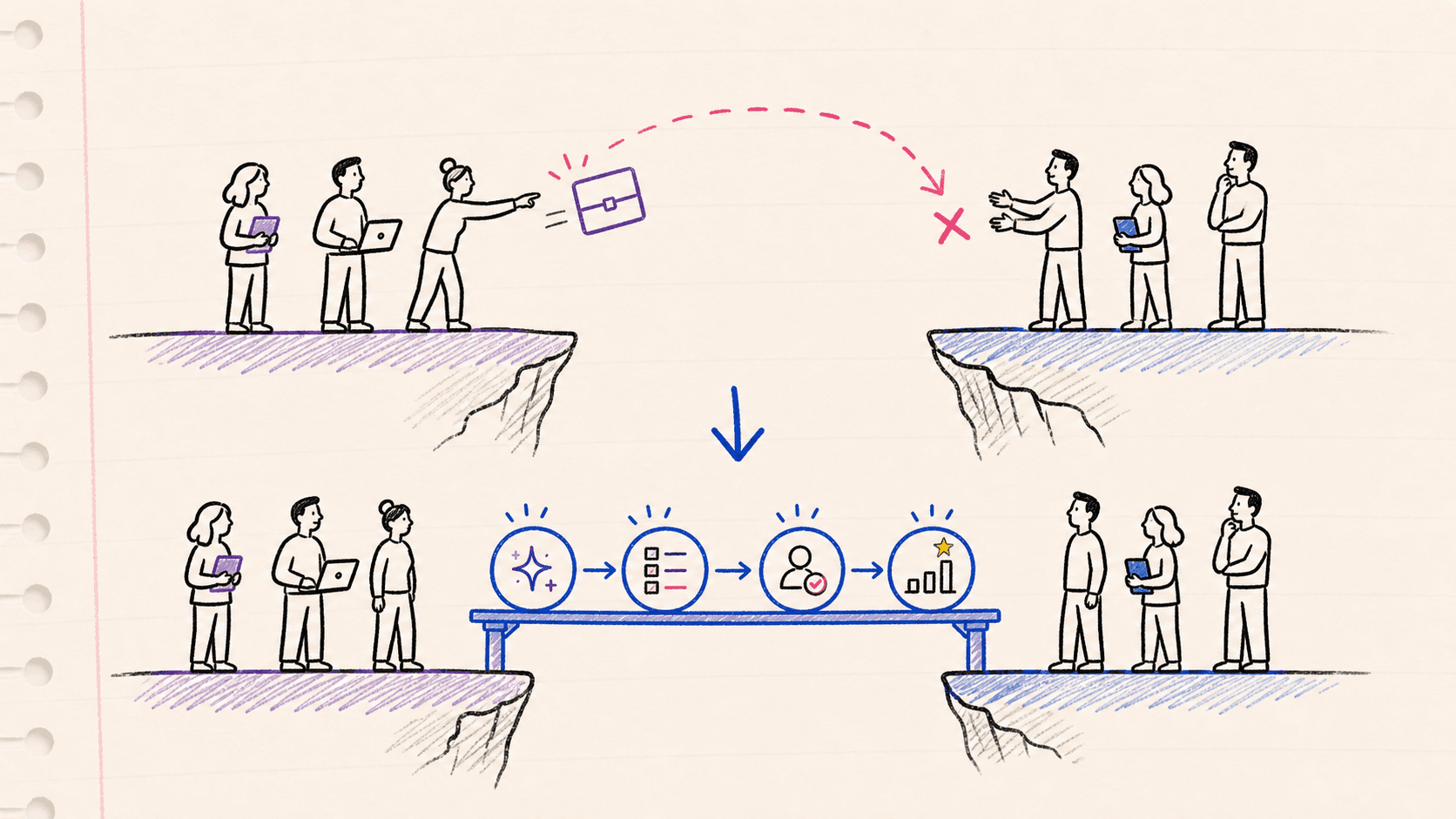
The failure can look like this. A buyer asks for a demo. The form creates a record, enrichment adds the company and an assignment rule drops it into a sales queue. The account already has an owner, so the new record looks like a duplicate. Nobody accepts it. An automatic email goes out anyway, and the workflow reports success.
The record moved; responsibility did not. A handoff dashboard can still mark that run as a success.
A marketing-to-sales handoff finishes when an eligible buyer reaches the right owner with enough context to act, that owner accepts the work and the outcome comes back into the system. Assignment is only one event along the way.
What a marketing-to-sales handoff actually is
The word suggests that marketing finishes its work and passes a complete package to sales. B2B buying is messier. Someone may research anonymously, download material for a future project, return with colleagues and only later request a conversation. Depending on the business, the thing being routed could be a contact, an account or a group of buyers.
The handoff is therefore a change in commercial responsibility. Before the change, marketing is responsible for interpreting and developing the signal. After it, a named sales owner is responsible for accepting, working or returning it with a usable reason. The system between them has to preserve the evidence that justified the change.
The action, account context and agreed criteria that indicate a sales conversation is appropriate.
A named person or actively managed queue accepts the record, its context and the response clock.
The buyer is contacted, qualified, returned, recycled or disqualified with a reason that improves the next decision.
An email proves that a notification was sent. A changed CRM owner proves that a field changed. Look for acceptance and action before calling either one a completed handoff.
Not every marketing signal belongs in sales
Many handoff disputes begin before routing. A webinar registration, repeated website visits and a demo request all enter the same queue because marketing and sales never agreed what each signal means.
In its 2025 B2B Buyer Experience Report, 6sense surveyed nearly 4,000 recent buyers and found that buyers initiated 79% of first engagements with sellers. On average, first contact happened 61% of the way through the reported buying journey. The percentages will vary by market. They are still a useful warning against treating every act of research as a request for sales contact.
That means an interaction is evidence, not an automatic instruction for sales. The system needs to distinguish at least three kinds of signal.
A contact, demo, pricing or consultation request should enter a priority route with a clear owner, relevant context and an agreed response clock.
Repeated activity across relevant people, product use or another defined signal may justify account review and considered outreach, but it is not the same as consent to an immediate sales conversation.
A report download, newsletter subscription or single event registration usually belongs in an appropriate follow-up or nurture path unless other evidence changes its meaning.
This gives sales fewer records with a clearer reason to act, and it keeps early research out of a sales process it did not ask for. When one signal class keeps coming back as “too early,” inspect the entry rule.
Define the handoff contract before automating it
A handoff contract is simply the set of rules marketing, sales and revenue operations agree to use. Keep it short enough to inspect and specific enough that the workflow does not remake the decision for every record.
- Unit of demand
- Are you routing a person, a company, an opportunity or a buying group assembled from several contacts?
- Entry rule
- Which observable evidence makes this record eligible, and which conditions suppress or delay it?
- Required context
- Which source, action, account facts, prior conversations and consent information must travel with it?
- Route and fallback
- Who should receive it, and where does it go when territory, ownership, capacity or data does not match the main rule?
- Acceptance
- Which recorded event proves that the receiving owner has taken responsibility rather than merely received a notification?
- Response clock
- When does the clock start, what counts as a meaningful response and which exceptions pause or change the expectation?
- Disposition
- Which outcomes can the owner record, including accepted, contacted, qualified, returned, recycled, duplicate and disqualified?
- Review trigger
- Which evidence should reopen the rule, such as repeated returns, a new segment, changed territories or a growing exception queue?
Simple routing often breaks on timing and data location. A rule can use only the information available where and when it runs. Salesforce documented in June 2026, for example, that standard lead assignment rules cannot evaluate Campaign fields for several lead creation paths because campaign membership sits on a separate record. The diagram can look right while the rule lacks the context it expects.
The general lesson applies beyond one platform. For every routing condition, check where the data originates, when it becomes available, which object holds it and what happens when it is missing. A fallback queue only works if somebody owns the queue and the system raises an exception before the record becomes stale.
A lead is not handed off when it is assigned
Give the handoff visible states. Each needs an entry event, an owner and a valid next move; otherwise a status such as “qualified” starts carrying several incompatible meanings.
- 01Captured
The original action and source are recorded without yet claiming that sales should act.
- 02Eligible
The record meets the agreed entry rule and carries the required context.
- 03Routed
A rule assigns a named owner or managed queue and starts the relevant clock.
- 04Accepted
The receiving owner acknowledges responsibility or returns the record through a defined exception path.
- 05Worked
A meaningful action occurs and its timestamp is recorded separately from an automated acknowledgement.
- 06Resolved
The commercial outcome and reason are recorded so marketing, sales and operations can learn from it.
The path can run backwards. Duplicates return, early records recycle and information requests go back to marketing. Those are legitimate outcomes when the reason is recorded. A record that disappears from a queue is a leak.
Modern CRM platforms can expose much of this without a separate analytics project. HubSpot’s current lifecycle stage documentation, for example, distinguishes lifecycle stage from Lead Status and provides calculated properties for the dates records enter and exit stages, plus time spent in a stage. The tool does not decide what your stages should mean, but the underlying events make waiting time and skipped states measurable.
Who should own the handoff?
One operating owner should maintain the states, routing logic and exception review. Revenue operations is a common home; a smaller team may give the job to marketing operations or a commercial leader who can see both sides.
The operating owner maintains the contract. Marketing and sales leaders approve what crosses the boundary and what response they expect from their teams.
Maintains the definitions, fields, routing rules, timestamps, fallback paths and exception review. Smaller companies may place this responsibility with a commercial leader.
Approve which demand deserves sales capacity, what response is expected and which return reasons are valid. A senior commercial leader resolves trade-offs that affect targets or territory.
Capture the evidence, keep queue coverage realistic, accept the work and record what happened. Their recurring exceptions show where the contract needs to change.
Suppose marketing wants to route every attendee from an expensive event, while sales points out that the list includes researchers, partners and existing customers. A lower lead-score threshold will not settle that disagreement. Define which event behaviours and account traits make a record eligible, then compare the progress of accepted and returned records. Change the contract when those records reveal a better rule.
Six common handoff failures and what they reveal
Handoff problems are easier to diagnose when the visible symptom is connected to the missing control. The following patterns are not proof of one cause, but they give the audit somewhere specific to begin.
| What you can observe | What to inspect |
|---|---|
| Assigned but never workedThe CRM shows an owner, yet no meaningful action follows. | There may be no acceptance state, no response clock or no escalation when an owner is unavailable. |
| Returned as poor qualitySales sends back a large share of one campaign or source. | The entry rule may confuse research activity with buying intent, or required account context may be missing. |
| Correct person, wrong ownerA new contact routes away from the seller already working the account. | Identity resolution, account matching or existing ownership may happen after the assignment rule. |
| Records collect in a queueThe main rules run, but exceptions wait without a decision. | The fallback has a destination but no active owner, capacity rule or escalation deadline. |
| Timing is the only return reasonMarketing receives no explanation beyond not now. | The disposition model may be too vague to distinguish early research, missing budget, wrong person or a future review date. |
| Lead volume rises while acceptance fallsMore records cross the boundary, but sales accepts a smaller share. | Scoring, capacity and the definition of eligible demand may not have changed together. |
Several symptoms can share one cause. Missing account matching can create duplicates, wrong owners and false response-time breaches. This is why the audit should trace records through actual events rather than inferring the problem from a single dashboard.
Where AI belongs in the handoff
AI can assemble account history, flag likely duplicates, extract the reason for a request and summarise prior conversations. It can recommend a route or draft a response, saving the owner from searching across several systems.
Keep consent, suppression, territory authority, permissions, fallback owners and escalation deadlines deterministic. These are known controls. A model’s interpretation of the wording should not change them.
New segments, strategic accounts and ownership conflicts need someone with authority to inspect the exception. Most records can still move automatically; the human owns the cases that expose a weakness in the rule.
Enrich context, summarise history, detect duplicates, classify requests, suggest a route and monitor the response clock.
Apply consent, permissions, territories, exclusions, required fields, named fallbacks and escalation rules consistently.
Handle novel exceptions, accept commercial trade-offs and decide whether new evidence warrants a change to the operating rule.
The NIST Generative AI Profile warns about automation bias and describes high-integrity information as information that keeps fact, opinion and inference distinct and linked to sources. A handoff summary should therefore show where each material fact came from and mark model interpretation clearly.
How to audit the handoff in an afternoon
Choose a recent cohort large enough to show the normal paths. Separate explicit buyer requests, research engagement and account-level signals before calculating speed or conversion; they enter for different reasons.
- 01Reconstruct the event path
Export the original action, source, creation time, eligibility time, owner history, acceptance event, first meaningful response, current state, outcome and reason. Note which events do not exist or cannot be trusted.
- 02Measure coverage before conversion
Calculate the share of eligible records with a valid owner, the share accepted, the share worked and the share with a complete disposition. A conversion rate cannot explain records that never entered a workable process.
- 03Measure waiting, including the tail
Look at the median time from eligibility to acceptance and from acceptance to meaningful action, then inspect the slowest portion separately. A healthy median can hide a group of records that waited for days.
- 04Read the exception paths
Group returns, duplicates, no-owner records, stale queues and overrides by source, segment and route. Trace examples from each group through the systems that touched them.
- 05Compare the written definitions
Ask marketing and sales to state, separately, which evidence makes a record eligible, what sales commits to do and which return reasons are valid. Compare those answers with the rules running in the systems.
- 06Follow the learning back
Check whether sales outcomes change scoring, campaign treatment, audience choices or follow-up. If the information stops at a dashboard, the return path is not improving the next handoff.
A 2026 Qualified survey of 514 B2B marketing and revenue leaders reported that only 7.2% of respondents said their company responded to demo requests within five minutes, and that roughly one in ten inbound leads was never contacted. Qualified sells inbound-engagement software and the responses were self-reported. Use the figures as a prompt to inspect your own records, then set a benchmark that reflects your buyers, routes and capacity.
How to redesign the handoff
Choose one type of demand that matters and currently creates disagreement, such as demo requests from existing target accounts. Write the contract for that path, have marketing and sales leadership approve it, then add the missing acceptance, return and fallback states. Test normal records and known exceptions before the rule touches live work.
Once it is running, read the exceptions more closely than the averages. An empty fallback queue may mean that routing works, or that records fail before reaching the queue. A rising return rate may show weaker demand, or simply more honest recording. Open a sample before changing the rule.
Revisit the contract when territories or products change, one source produces repeated returns, accepted records stop progressing or automation changes the context available to the owner. The workflow should follow the business as it changes.
Questions worth answering
- What is a marketing and sales handoff?
- It is the point where a person or account leaves a marketing-owned stage and enters a sales-owned action. The handoff should state what qualifies, what context travels with the record, who accepts it, how quickly they act and what happens after a rejection or routing failure.
- Who owns the handoff between marketing and sales?
- Marketing and Sales should approve the definition together. Marketing owns the evidence it sends; Sales owns acceptance and follow-up. Revenue Operations usually builds the stages, routing and reporting. One person should watch the whole transfer for failures.
- Which metrics show whether the handoff is working?
- Track successful routing, time to acceptance, time to first useful action, rejection reasons, ownerless records, recycled records and progress after acceptance. Follow the same group of records across the handoff; separate Marketing and Sales totals hide the leak.
- Can AI fix a weak marketing and sales handoff?
- AI can classify, enrich, summarise and prioritise records. It cannot repair an undefined qualification rule or decide who owns the follow-up. Set those rules first, then automate the stable parts and keep important customer decisions reviewable.